Why Is My Furnace Leaking Water?
Anderson Heating & Cooling •
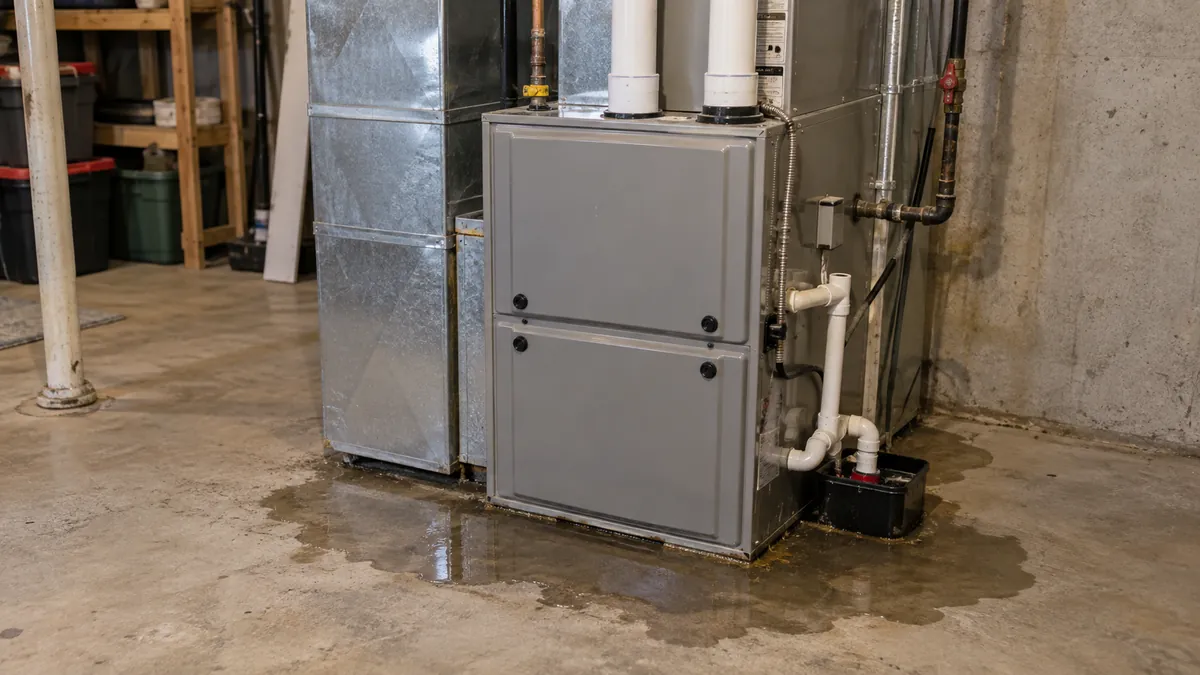
A furnace leaking water almost always has a drainage problem. Nothing inside it has burst. Water that's supposed to go down a drain is simply ending up on your floor instead.
Finding out which drain comes down to two questions. What kind of furnace do you have? And was the heat or the air conditioning running when the puddle showed up?
October makes the second one harder than it sounds, since plenty of homes run the AC on Monday and the heat by Friday.
If there's water on the floor right now, switch the system off at the thermostat and mop up first. You can figure out the cause once things are dry.
Start With the Vent Pipe
Head to the furnace and look at the pipe that carries its exhaust outside.
White PVC leaving through a side wall of the house (sometimes one pipe, sometimes two) means you have a high-efficiency furnace, also called a condensing furnace.
If it's a single metal pipe going up into a chimney or through the roof, you have a standard-efficiency furnace.
This is the most useful thing to know, because the two behave very differently. A condensing furnace makes water every time it heats. A standard furnace shouldn't make any.
Why a Condensing Furnace Makes Water
A condensing furnace squeezes extra heat out of its exhaust using a second heat exchanger. Once the exhaust cools enough, the moisture in it condenses, the same way water beads up on a glass of ice water.
That water is slightly acidic. It's meant to run through a small trap and tube to a floor drain, or into a little pump that sends it there.
Colder weather means longer run times, and longer run times mean more water. So a drain that kept up fine all through September can start overflowing the first time the temperature really drops.
Leaks From a Condensing Furnace During Heating
The Drain Line or Trap Is Clogged
This is the most common one. Over months of use, a slimy film and bits of sediment collect in the trap and tubing until the water can't get past.
It backs up and finds the nearest way out, usually a loose joint or the bottom of the cabinet.
A blocked drain can also set off the switch that keeps the furnace from overflowing, and that switch shuts the burners down.
If your leak showed up around the same time the furnace started short cycling or blowing cold air, there's a good chance one clog is behind both.
The Condensate Pump Quit
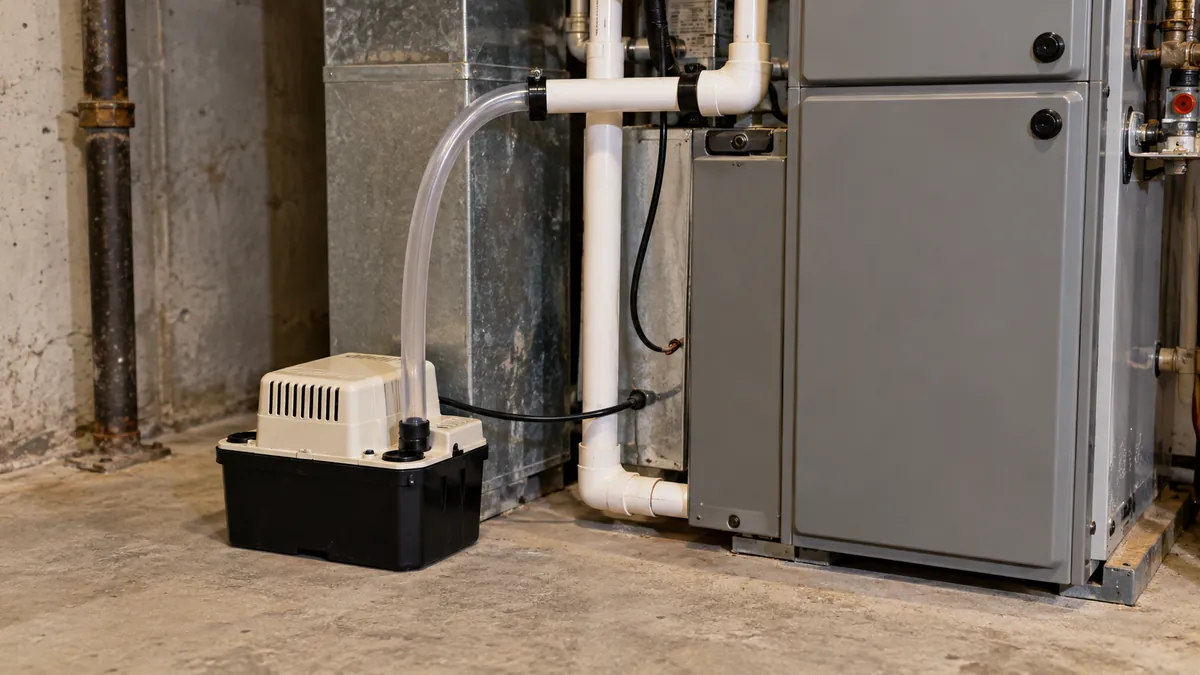
Not every furnace sits near a floor drain. When it doesn't, a small pump beside it collects the water and pushes it away through a thin tube. When that pump stops, the tank fills and spills over.
First, make sure it's plugged in and the outlet works. Plugging in a lamp is a quick way to tell.
If the outlet has power and the tank is full but the pump just sits there, the pump has most likely died. Swapping one out is a routine repair.
Part of the Line Froze
Some drain tubes take a route through a garage, a crawlspace, or an outside wall. On a bitter Northeast Ohio night, water sitting in that stretch can freeze solid.
By morning it's backed up and dripping at the furnace, even though the drain was fine the week before.
Keep heat guns and torches away from plastic drain lines. We can thaw and clear the line, then insulate or reroute the part that keeps freezing.
A Connection Came Loose
Sometimes a piece of tubing just slips off its fitting. It happens most often right after a furnace has been installed or serviced. Run your fingers along the drain line and check each joint for drips.
The Water Starts Inside the Furnace
If it looks like the water is coming from inside the cabinet, or the bottom of the furnace has started to rust, an internal part may be leaking, such as the secondary heat exchanger.
Leave this one to a technician, and keep the furnace off until it's been checked.
When the Air Conditioner Was Running
In most homes with central air, the AC's indoor coil sits right on top of the furnace. As it cools, it pulls moisture out of the air, and that water drips into a pan with a drain line of its own.
When that line clogs, the pan overflows and the water runs straight down into the furnace cabinet. It really does look like the furnace is leaking, but the furnace isn't to blame.
A frozen coil can leave the same kind of puddle. Ice builds up when refrigerant runs low or the filter gets dirty, and once the AC shuts off, it all melts faster than the pan can drain it.
Spot frost on the coil or the copper lines? Turn the AC off and let everything thaw before you run it again.
Either way, it's a job for AC repair. And to keep it from happening again next summer, ask us to look at the AC drain during your spring AC tune-up.
Water Around a Standard-Efficiency Furnace
A standard furnace shouldn't make water while it heats. So if you're finding water around one in the middle of winter, it's coming from something else.
Start with the humidifier, if you have one mounted on the ductwork.
Whole-house humidifiers have their own water line and drain, and a stuck valve or cracked tube can send water running down the side of the furnace.
White mineral crust on or under the humidifier is a pretty good sign it's the culprit.
Next, look at the metal vent pipe. Drips or rust streaks along it can mean the exhaust is cooling and condensing before it makes it outside.
That usually points to a venting problem, and poor venting can let carbon monoxide back into the house. Turn the furnace off and give us a call. Our carbon monoxide safety guide explains why venting matters so much.
If neither of those is it, look around the room. Water heaters, floor drains, and overhead pipes often share space with the furnace.
Dry the floor, come back in an hour, and see where the water shows up first. Sometimes the leak turns out to be the water heater a few feet away.
What to Do Right Now
Whatever kind of furnace you have, these steps are safe to start with.
- Turn the system off at the thermostat. If water is anywhere near the furnace's wiring, also shut it off at the service switch or breaker. Just don't stand in water to do it.
- Dry the area. Water left sitting on a basement floor can ruin flooring and start growing mold.
- Check the pump and drain. Make sure the pump is plugged in, then follow the drain tube to its end and see that it isn't blocked or kinked.
- Make a note of what happened. Was it the heat or the AC? How much water, and where did it collect? A technician can use that to find the source on the first visit.
Anything inside the cabinet, including the drain fittings and anything near the burners, is best left to us.
When a Leak Needs a Technician
Call us if the water comes back after you've cleaned up, if it's starting inside the cabinet, if the furnace is rusting, or if a standard furnace is dripping from its vent.
It's also worth a call when the leak shows up along with the furnace shutting off or not heating.
Our furnace repair team works throughout Elyria, Lorain County, and the west side of Cleveland every day of the week, and we answer emergency calls around the clock.
Before anything gets fixed, you'll have an itemized quote in hand. Call (440) 221-7978.
Drain trouble tends to build slowly, which makes it easy to catch early. If you're booking a fall furnace tune-up, mention the drain and pump so we can check them while we're there.