
Anderson Heating & Cooling •
A furnace running for six or seven months straight, in a house sealed tight against Lake Erie’s wind and snow, is exactly the combination that makes carbon monoxide worth understanding properly rather than filing under “things I have a detector for.” The detector matters, but it’s the last line of defense, not the plan.
The rest of this covers three things: the specific furnace failures that produce CO, why Cleveland’s west side runs a higher version of that risk than a milder climate would, and what real protection looks like once you get past the unit mounted on your ceiling.
Why a Long, Sealed Heating Season Raises the Stakes
Carbon monoxide is a byproduct of burning fuel. In a properly running gas furnace, it’s produced inside the heat exchanger and vented outside before it ever touches the air moving through your ducts. The risk shows up when that separation fails, either through a compromised heat exchanger or a blocked vent, and two things about a west side Cleveland winter make that failure more consequential than it would be somewhere milder.
The first is how long the season runs. A furnace here operates from October through April in a typical year, which means far more total cycles, and far more opportunity for wear, than equipment in a place where heating season lasts eight or ten weeks.
The second is how tightly modern homes are built to survive that season. Good insulation and air sealing keep heating bills down, but they also reduce the natural air exchange that would otherwise dilute a small CO release before it became dangerous. A leaky older home has an accidental safety margin that a well-sealed one doesn’t, which is exactly why the equipment itself has to be doing its job correctly.
Where It Comes From
A cracked heat exchanger.
Metal expands when it heats and contracts as it cools, and that repeated cycle, multiplied across a full Ohio heating season, is the primary driver of heat exchanger fatigue over the years. A crack lets combustion gases leak straight into the air your blower pushes through the house, and there’s nothing about the outside of the unit that would tell you it’s happening. A technician has to actually look for it — you won’t hear or see it coming from the cabinet.
A blocked or damaged flue.
Combustion gases need a clear path outside. Bird nests, debris, and ice buildup at the vent termination are common in this region, and a flue that can’t draft properly pushes exhaust back toward the mechanical space instead of outside.
Incomplete combustion.
Dirty burners or incorrect gas pressure shift the combustion process toward producing more CO, even when the heat exchanger itself is intact. This is one of the things a combustion analysis during a tune-up is specifically designed to catch.
An attached garage.
A vehicle left running in an attached garage, even briefly, can push CO into the connected living space, and a tightly sealed home doesn’t dilute it the way an older, leakier one might.
The Symptoms People Write Off as Something Else
Early CO exposure tends to mimic a bad cold or a mild flu: headache first, then dizziness, tiredness, nausea, and trouble concentrating as exposure continues. That resemblance is exactly why it’s so often missed.
What separates it from an actual cold: it gets better when you’re away from the house and comes back once you’re inside again. More than one person in the household feeling the same way at the same time. A dog or cat acting unusually lethargic or off. Symptoms that line up with whenever the furnace has been running.
If that pattern sounds familiar, get everyone into fresh air and treat it as a real possibility, not a coincidence.
What a Detector Does and Doesn’t Do
Every home with a fuel-burning furnace needs working CO detectors on every level and near sleeping areas. That’s not optional. What’s less understood is the detector’s actual role in the safety picture.
Most CO sensors lose reliable sensitivity within five to seven years of installation, even if the unit still lights up and beeps correctly when you press the test button — the test button checks the circuit, not the sensor’s actual accuracy. Look for the manufacture date printed on the back of each detector and swap out anything that’s aged past that range.
More importantly, by the time a detector sounds, CO has already reached a concentration inside your home high enough to set it off — it’s telling you something went wrong, not stopping it from happening. Real prevention happens upstream of that alarm: equipment that gets inspected and serviced on a set schedule instead of running until something finally trips the sensor.
What an Inspection Checks
A heating inspection and maintenance aimed at CO risk covers more than a visual glance at the furnace.
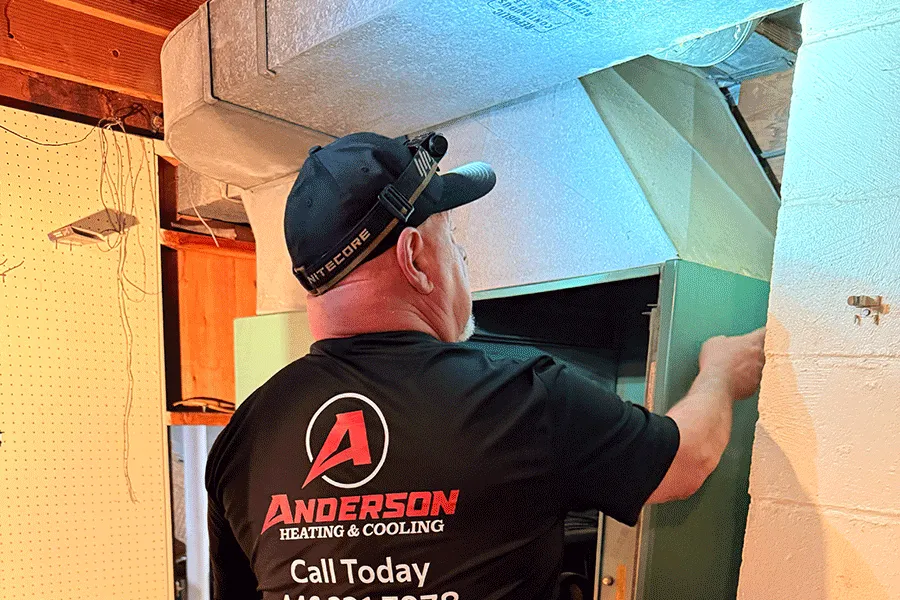
Heat exchanger inspection, often with a camera to see interior surfaces that aren’t otherwise visible, looks specifically for the cracks or separation that let combustion gas into circulated air.
Combustion analysis measures the actual makeup of flue gases, including CO output, rather than assuming the burner is fine because the furnace sounds normal. A furnace can look and run exactly as expected while still producing CO levels well above what proper combustion should generate.
Flue and venting inspection confirms combustion gases have a clear, open path outside, which matters more in Cleveland winters than people think given how much debris and ice can build up around exterior vent terminations by January.
Anderson’s repair and servicing team includes these checks as a standard part of any heating service call, not something added on top.
Before the Season Gets Fully Underway
Test every CO detector in the home and check the manufacture date on the back of each one. Replace anything past seven years old, even if it still passes its test button.
Never let a car idle in an attached garage, even for a few minutes, especially with the door leading into the house nearby.
If your furnace hasn’t had a professional look in the past year, get it done before the coldest stretch of the season rather than after something feels off. A system that’s inspected proactively gets a straightforward repair. One that’s ignored until it fails gets diagnosed during an emergency call, which is a worse position for everyone involved.
Anderson has served Elyria, Avon Lake, Avon, North Ridgeville, Westlake, Fairview Park, Lakewood, and Olmsted Falls for over 20 years, and maintenance plans are built around exactly this kind of proactive check rather than a reactive one. Schedule a visit with Anderson Heating and Cooling today and get your system looked at before winter settles in for good.
A well-sealed, well-insulated home is exactly what you want on Cleveland’s west side. It’s also exactly why the furnace producing your heat needs to be doing its job correctly.